
Variance and Volatility Swaps in the Heston Model
Introduction
Rather than gaining exposure to the market's volatility
through standard call and put options, investors can take views on the future
realized volatility directly by trading derivatives on variance and volatility. The simplest such instruments are variance and
volatility swaps.
A volatility swap is a forward contract on future realized
price volatility. Similarly, a variance
swap is a forward contract on future realized price variance, variance being
the square of volatility. At expiry the
receiver of the “floating leg” pays (or owes) the difference between the
realized variance (or volatility) and the agreed upon strike. At inception the
strike is generally chosen such that the fair value of the swap is zero. This
strike is referred to as fair variance (or fair volatility).
Both swaps provide pure exposure to volatility alone,
unlike vanilla options in which the volatility exposure depends on the price of
the underlying asset. These swaps can
thus be used to speculate on future realized volatility, to trade the spread
between realized and implied volatility, or to hedge the volatility exposure of
other positions.
More exotic products include conditional variance swaps,
options on variance swaps and covariance and correlation swaps. Using
conditional variance swaps, and options on realized variance or volatility,
investors can trade volatility while protecting themselves from large spikes.
Covariance and correlation swaps can be used to take views on the correlation
between two or more assets and are popular in FX markets.
In the Heston model [4],
arguably the most popular model of stochastic volatility, the fair variance of
a variance swap and the fair volatility of a volatility swap may be computed
analytically. In this two-factor model, both the price and the variance are
assumed to be stochastic. The price process resembles a geometric Brownian
motion and the variance process is a mean reverting square-root process first
introduced in short term interest models [2].
The variability of the volatility then allows for a
description of the market's implied volatility surface (the volatility smile)
in the Heston model. The model is described in detail in the FINCAD Math
Reference document Option Pricing with the Heston Model of
Stochastic Volatility.
The functions described in this document provide valuation
of variance and volatility swaps in the Heston model. Model independent
valuation of these vanilla swaps is covered by FINCAD functions as described in
the FINCAD Math Reference document Variance and Volatility Swaps.
Analysis Supported
FINCAD Heston volatility and variance swap functions can be
used for the following analysis:
·
calibration of the Heston model parameters to
market data on variance or volatility swaps
·
calculation of fair variance for a variance swap
and fair volatility for a volatility swap in the Heston model; calculation of risk
statistics for fair variance and fair volatility respectively.
·
calculation of fair value for both variance and
volatility swaps in the Heston model, given the realized variance or volatility
to date; calculation of risk statistics for variance swaps and volatility swaps
Technical Details
Variance Swaps
At maturity, the payoff of a variance swap is
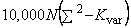
Equation 1
where
 = notional amount quoted in $ per
volatility point squared (hence the factor of
= notional amount quoted in $ per
volatility point squared (hence the factor of  =
10,000)
=
10,000)
 = realized variance in
the underlying asset during the life of the swap
= realized variance in
the underlying asset during the life of the swap
 = strike on variance
The (annualized) realized variance over the time period
[0,  ] measured in years (the remaining life of the swap) is given
by
] measured in years (the remaining life of the swap) is given
by
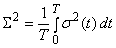
Equation 2
where
 = volatility of the
return on the underlying asset.
= volatility of the
return on the underlying asset.
At inception, the strike of the swap is chosen
such that the expected payoff is zero:
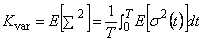
Equation 3
This is called the fair variance of a variance swap.
If the swap is already in effect and is being
valued at some time  such that
  , then the present value of the swap can be calculated by
combining the realized variance up to the value date with the expected realized
variance for the remainder of the swap's life.
The present value is then
, then the present value of the swap can be calculated by
combining the realized variance up to the value date with the expected realized
variance for the remainder of the swap's life.
The present value is then

Equation 4
where

 = realized variance up to the value date
 = fair variance for
the remaining life of the swap
= fair variance for
the remaining life of the swap
Volatility Swaps
The definition of the volatility swap is analogous to that
of the variance swap. At maturity, the
payoff of a volatility swap is
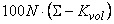
Equation 5
where
= notional amount
quoted in $ per volatility point (hence the factor of 100)
 = realized volatility
in the underlying asset during the life of the swap
= realized volatility
in the underlying asset during the life of the swap
 = the strike on
volatility
= the strike on
volatility
At inception, the strike of the swap is chosen
such that the expected payoff is zero:
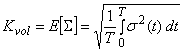
Equation 6
This is called the fair volatility.
If the swap is already in effect and is being
valued at some time such that , then the present value of the swap can be calculated by
combining the realized volatility up to the value date with the expected
realized volatility for the remainder of the swap's life. The present value is then

Equation 7
where now

since it is variance, and not volatility, which is
additive.
Heston Model
In the Heston model, the underlying asset price  follows a standard
lognormal process and the instantaneous variance
follows a standard
lognormal process and the instantaneous variance  follows a mean
reverting square-root process:
follows a mean
reverting square-root process:
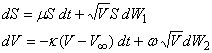
Equation 8
where
= price of the
underlying asset
= variance of the
asset price
 = rate of return of
the asset
= rate of return of
the asset
 and
and  = Brownian motions
correlated via
= Brownian motions
correlated via 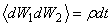 , ρ being the
correlation.
, ρ being the
correlation.
 ,
,  ,
,  ,
,  = parameters of the
Heston model: speed of mean reversion, initial volatility, long-term volatility
and volatility of volatility.
= parameters of the
Heston model: speed of mean reversion, initial volatility, long-term volatility
and volatility of volatility.
By integrating the stochastic differential
equation of the instantaneous variance and taking expectations, the expectation
value of instantaneous variance at time  is:
is:
 .
.
Equation 9
The annualized expectation value for the total
realized variance (in the time interval  ) is then
 .
.
Equation 10
This expectation value is the fair variance of a
variance swap in the Heston model.
The volatility expectation value which is
equivalent to the fair volatility of a volatility swap cannot be computed as
easily in the Heston model. A second order Taylor expansion of  leads to the following approximation for the volatility
expectation value [1]:
leads to the following approximation for the volatility
expectation value [1]:
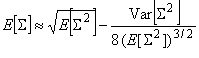
Equation 11
where
 = the variance of
variance given by
= the variance of
variance given by

Equation 12
Note that the second order approximation of the
fair variance given in Equation 11
can become negative, although the fair variance is always positive.
Alternatively, the volatility expectation value
can be computed to all orders by numerically solving the integral [1],
[3]
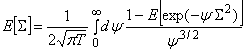
Equation 13
where

with
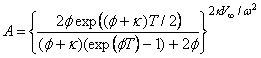
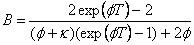
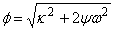 .
.
In the Heston model, the fair volatility of a volatility
swap can therefore be approximated with a first or second order expression or
computed to all orders by numerically solving an integral.
Calibration
Based on the expectation values for variance and
volatility, it is possible to calibrate the Heston model to market data on
variance and volatility swaps, respectively. For the calibration to variance
swaps the user enters fair variances of swaps with different maturities and a
method of weighting these market data. Here, uncertainties for each swap can be
entered or the swaps can be weighted equally or relative to the values of fair
variance.
In the case of volatility swaps the user provides market
data on volatility swaps and a choice of weighting these data with associated
uncertainties, equal weights or relative weights. The user also chooses a
method for the calculation of fair volatility. As described above the fair
volatility can be calculated using a first or second order approximation or a
numerical integration to all orders.
The search for the parameters that best describe these
input data starts at initial parameter values and extends over a given range of
parameters, both entered by the user. Based on these inputs the calibration is
carried out by the FINCAD calibration engine.
This engine provides the user with a choice of three
optimization algorithms: Levenberg Marquardt, downhill simplex and differential
evolution. Based on one of three error metrics ( , weighted
  , or weighted
  ) these algorithms search for the model parameters that best
describe the input data using the equations of fair variance and fair
volatility respectively, as given above.
) these algorithms search for the model parameters that best
describe the input data using the equations of fair variance and fair
volatility respectively, as given above.
For more details on the calibration engine the reader is
referred to the FINCAD Math Reference documents Option Pricing with the Heston Model of
Stochastic Volatility and Calibration of Interest Rate Models..
Functions
|
|
Valuation |
Calibration |
|
Variance Swaps |
||
|
Volatility Swaps |
Naming Conventions
|
Suffix/ Prefix |
Description |
|
_iv |
computes the fair variance (volatility) and corresponding
Greeks for a variance (volatility) swap |
|
_p |
computes the fair value and corresponding Greeks |
|
Calibrate |
calibrates the Heston model parameters to market data on
variance swaps or volatility swaps |
aaVarianceSwap_Heston_iv: Outputs
|
Output Statistic |
Description |
|
fair variance |
the fair variance in units of variance |
|
fair variance as volatility |
the square root of the fair variance |
|
theta |
rate of change in fair variance per one day decrease in
time. This is the negative of the derivative of the fair variance with
respect to time (in years), divided by 365 |
|
sensitivity to initial volatility |
rate of change in fair variance per 1% change in initial
annual volatility. This is the
derivative of the fair variance with respect to the initial annual
volatility, divided by 100 |
|
sensitivity to long-term volatility |
rate of change in fair variance per 1% change in long-term
annual volatility. This is the derivative
of the fair variance with respect to the long-term annual volatility, divided
by 100 |
|
sensitivity to speed of mean reversion |
rate of change in fair variance per change in the speed of
mean reversion. This is the derivative
of the fair variance with respect to the speed of mean reversion |
|
number of market days |
the number of days that the swap is active; calculated
based on the input accrual method |
aaVarianceSwap_Heston_p: Outputs
|
Output Statistic |
Description |
|
fair value |
the fair value of the variance swap at the value date |
|
sensitivity to realized variance |
rate of change in fair value per 1% change in realized
volatility. This is the derivative of fair value with respect to realized
variance, divided by 10,000 |
|
sensitivity to implied variance |
rate of change in fair value per 1% change in implied
volatility. This is the derivative of the fair value with respect to implied
variance, divided by 10,000 |
|
theta |
rate of change in fair value per one day decrease in time.
This is the negative of the derivative of the fair value with respect to time
(in years), divided by 365 |
|
rho of rate |
rate of change in fair value per 1% change in the risk
free rate. This is the derivative of the fair value with respect to the
risk-free rate, divided by 100 |
|
sensitivity to initial volatility |
rate of change in fair value per 1% change in initial
annual volatility. This is the
derivative of the fair value with respect to the initial annual volatility,
divided by 100 |
|
sensitivity to long-term volatility |
rate of change in fair value per 1% change in long-term
annual volatility. This is the
derivative of the fair value with respect to the long-term annual volatility,
divided by 100 |
|
sensitivity to speed of mean reversion |
rate of change in fair value per change in the speed of
mean reversion. This is the derivative
of the fair value with respect to the speed of mean reversion |
|
combined variance |
the weighted average of the realized variance and the
implied variance in units of variance |
|
combined variance as volatility |
the square root of the combined variance |
|
number of market days passed |
the number of days that the swap has been active;
calculated based on the input accrual method |
|
number of market days remaining |
the number of days remaining in the life of the swap;
calculated based on the input accrual method |
aaVolatilitySwap_Heston_iv: Outputs
|
Output Statistic |
Description |
|
fair volatility |
the fair volatility |
|
theta |
rate of change in fair volatility per one day decrease in
time. This is the negative of the derivative of the fair volatility with
respect to time (in years), divided by 365 |
|
sensitivity to initial volatility |
rate of change in fair volatility per 1% change in initial
annual volatility. This is the derivative of
the fair volatility with respect to the initial annual volatility,
divided by 100 |
|
sensitivity to long-term volatility |
rate of change in fair volatility per 1% change in
long-term annual volatility. This is the derivative of the fair volatility
with respect to the long-term annual volatility, divided by 100 |
|
sensitivity to speed of mean reversion |
rate of change in fair volatility per change in the speed
of mean reversion. This is the derivative of the fair volatility with respect
to the speed of mean reversion |
|
sensitivity to volatility of volatility |
rate of change in fair volatility per change in the
volatility of volatility. This is the derivative of the fair volatility with
respect to the volatility of volatility |
|
number of market days |
the number of days that the swap is active; calculated
based on the input accrual method |
aaVolatilitySwap_Heston_p: Outputs
|
Output Statistic |
Description |
|
fair value |
the fair value of the volatility swap at the value date |
|
sensitivity to realized volatility |
rate of change in fair value per 1% change in realized
volatility. This is the derivative of the fair value with respect to realized
volatility, divided by 100 |
|
sensitivity to implied volatility |
rate of change in fair value per 1% change in implied
volatility. This is the derivative of the fair value with respect to implied
volatility, divided by 100 |
|
theta |
rate of change in fair value per one day decrease in time.
This is the negative of the derivative of the fair value with respect to time
(in years), divided by 365 |
|
rho of rate |
rate of change in fair value per 1% change in the risk
free rate. This is the derivative of the fair value with respect to the
risk-free rate, divided by 100. |
|
sensitivity to initial volatility |
rate of change in fair value per 1% change in initial
annual volatility. This is the
derivative of the fair value with respect to the initial annual volatility,
divided by 100 |
|
sensitivity to long-term volatility |
rate of change in fair value per 1% change in long-term
annual volatility. This is the derivative
of the fair value with respect to the long-term annual volatility, divided by
100 |
|
sensitivity to speed of mean reversion |
rate of change in fair value per change in the speed of
mean reversion. This is the derivative
of the fair value with respect to the speed of mean reversion |
|
sensitivity to volatility of volatility |
rate of change in fair value per change in the volatility
of volatility. This is the derivative of the fair value with respect to the
volatility of volatility |
|
combined volatility |
the weighted average of the realized volatility and the
implied volatility |
|
number of market days passed |
the number of days that the swap has been active;
calculated based on the input accrual method |
|
number of market days remaining |
the number of days remaining in the life of the swap;
calculated based on the input accrual method |
Market Data Requirements
The calibration
functions require as input market data on variance or volatility swaps. The
calibrated parameters that these functions output can be used as input to the
valuation functions.
Further details for these functions are provided in
the following data sources and FINCAD Math Reference documents:
·
FINCAD Math Reference document: Option Pricing with the Heston Model of
Stochastic Volatility
·
FINCAD Math Reference document: Calibration of
Interest Rate Models
·
FINCAD Math Reference document: Variance and
Volatility Swaps
·
Example
Example 1: Valuation
of a variance swap in the Heston model
On January 2, 2008, we seek to value a variance swap that
came into effect on November 1, 2007 and expires on February 1, 2008. We have a
calibrated Heston model available, which we would like to use for this
valuation. The example workbook shows how to compute the fair value of the
variance swap on the value date and how to compute the fair variance for the
remainder of the swap’s life.
 Valuation of a Variance Swap in the Heston Model Example
Related Functions
Model-Independent Pricing
|
|
Valuation |
|
Variance Swaps |
|
|
Volatility |
Heston Model
|
|
Valuation |
Calibration |
|
Options |
References
[1]
Brockhaus, O. (2000) 'Volatility swaps made
simple', Risk, January 2000, 92.
[2]
Cox, J. C., Ingersoll, J. E. and Ross,
S. A. (1985) 'A Theory
of the Term Structure of Interest Rate', Econometrica
53: 385-407.
[3]
Gatheral, J. (2006) The
Volatility Surface, 1st ed., Hoboken, NJ, Wiley Finance.
'
Disclaimer
With respect
to this document, FinancialCAD Corporation (“FINCAD”) makes no warranty either
express or implied, including, but not limited to, any implied warranty of
merchantability or fitness for a particular purpose. In no event shall FINCAD
be liable to anyone for special, collateral, incidental, or consequential
damages in connection with or arising out of the use of this document or the
information contained in it. This document should not be relied on as a
substitute for your own independent research or the advice of your professional
financial, accounting or other advisors.
This
information is subject to change without notice. FINCAD assumes no
responsibility for any errors in this document or their consequences and
reserves the right to make changes to this document without notice.
Copyright
Copyright ©
FinancialCAD Corporation 2008. All rights reserved.