
Variance and Volatility Swaps
Introduction
Rather than gaining exposure to the market's volatility
through standard call and put options, investors can take views on the future
realized volatility directly by trading derivatives on variance and volatility. The simplest such instruments are variance and
volatility swaps.
A volatility swap is a forward contract on future realized
price volatility. Similarly, a variance
swap is a forward contract on future realized price variance, variance being
the square of volatility. At expiry the
receiver of the “floating leg” pays (or owes) the difference between the
realized variance (or volatility) and the agreed upon strike. At inception the
strike is generally chosen such that the fair value of the swap is zero. This
strike is referred to as fair variance (or fair volatility).
Both swaps provide pure exposure to volatility alone,
unlike vanilla options in which the volatility exposure depends on the price of
the underlying asset. These swaps can
thus be used to speculate on future realized volatility, to trade the spread
between realized and implied volatility, or to hedge the volatility exposure of
other positions.
Variance swaps are theoretically simpler than volatility
swaps: they can be hedged with a static position in European call and put
options (with suitably chosen strikes), together with a dynamic position in the
underlying asset [2].
Volatility swaps, on the other hand, are
harder to hedge, although recent work suggests that it is possible [1].
To the extent that variance and volatility swaps can be
hedged using plain vanilla European call and put options, the pricing of such
instruments is possible in a model-independent manner: the price can be
calculated from market-observed prices of European options of different
strikes. The effects of the volatility
smile, for instance, are accounted for by construction.
Of course, the prices of variance and volatility swaps can
also be calculated within a model of asset price dynamics, and FINCAD also
provides the functionality to price such swaps using the Heston model of
stochastic volatility. This is described
in the Volatility
and Variance Swaps in the Heston Model FINCAD Math Reference document.
Analysis Supported
FINCAD variance and volatility swap functions can be used
for the following analysis:
·
calculation of fair variance for a variance swap
and fair volatility for a volatility swap in a model independent manner,
through replication arguments; calculation of the number of European options of
each strike needed to build the replicating portfolio; calculation of risk
statistics for fair variance and fair volatility respectively.
·
calculation of fair value for both variance and
volatility swaps, given the realized variance or volatility to date, and the
fair variance or volatility for the remaining life of the swap; calculation of risk
statistics for both variance and volatility swaps.
Technical Details
Variance Swaps
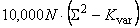
At maturity, the payoff of a variance swap
is
Equation 1
where
 = notional amount quoted in $ per volatility point squared
(hence the factor of
= notional amount quoted in $ per volatility point squared
(hence the factor of  = 10,000)
 = realized variance in
the underlying asset during the life of the swap
= realized variance in
the underlying asset during the life of the swap
 = strike on variance
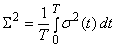
The
(annualized) realized variance over the time period [0,  ] measured in years (the remaining life of the swap) is given
by
] measured in years (the remaining life of the swap) is given
by
Equation 2
where
 = volatility of the
return on the underlying asset.
= volatility of the
return on the underlying asset.
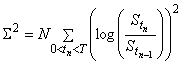
In practice,
the variance is calculated with daily monitoring of the log-return of the
underlying asset
Equation 3
where
= normalization factor, for example 252/(total number of days
between 0 and )
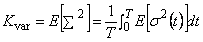
At inception,
the strike of the swap is chosen such that the expected payoff is zero:
Equation
4
This is called the fair
variance of a variance swap.
If the swap is already
in effect and is being valued at some time  such that
  , then the present value of the swap can be calculated by
combining the realized variance up to the value date with the expected realized
variance for the remainder of the swap's life.
The present value is then
, then the present value of the swap can be calculated by
combining the realized variance up to the value date with the expected realized
variance for the remainder of the swap's life.
The present value is then

Equation 5
where

 = realized variance up to the value date τ
 = fair variance for
the remaining life of the swap
= fair variance for
the remaining life of the swap
Variance Swaps: Replication in Theory
To replicate the fair variance given in Equation 4
using European call and put options, we follow the description in [1]. Assuming that the underlying asset follows a
standard lognormal process

Equation 6
Ito's lemma implies
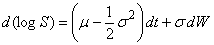
Equation 7
so by subtraction
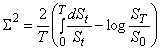
Equation 8
Denoting the risk-free interest rate and the
dividend yield by  and
and  respectively, in a
risk-neutral world the first term is equal to
respectively, in a
risk-neutral world the first term is equal to  . Choosing some
arbitrary value
. Choosing some
arbitrary value  , the second term - the log contract - is split according to
  , and one can show

Equation 9
The first term is  forward contracts
struck at , and the second (third) term is a portfolio of put (call)
options, each option being weighted by
forward contracts
struck at , and the second (third) term is a portfolio of put (call)
options, each option being weighted by  .
.
The fair variance can thus be written as
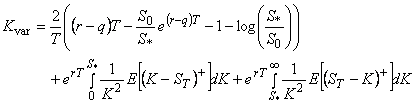
Equation 10
replication being achieved through a static position
in a portfolio of call and put options, a dynamic position in shares and some
cash. Note that the value of should generally be
the forward price or, in the discrete case, a value as close to the forward
price as possible. The portfolio would
thus entirely consist of out-of-the-money options.
Variance Swaps: Replication in Practice
In practice a portfolio of put and call options with
continuous strikes cannot be constructed.
The two integrals in Equation 10
can be approximated by a portfolio  of options with
discrete strikes, which together have the payoff
of options with
discrete strikes, which together have the payoff
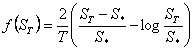
Equation 11
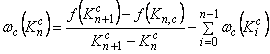
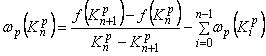
It turns out that this portfolio is given by a
sum over strikes

Equation 12
of call and put options with weights
 .
.
Equation 13
The functions described here allow the user to
enter an implied volatility smile. The
above replicating portfolio can then be constructed from options with the given
strikes (and implied volatilities). Alternatively,
the portfolio can be constructed from a given number of options with equally
spaced strikes between some minimum and maximum values.
In this case, the implied volatility smile is interpolated
and/or extrapolated to the relevant strikes, and there is a choice of
interpolating method: linear, cubic spline or smoothed cubic spline. The latter choice requires the input of a
smoothing parameter, giving rise to a cubic spline with a curvature penalty
term proportional to the smoothing parameter.
The resulting spline will no longer intersect with the points in the
original volatility smile, but will tend to smooth it out. As the smoothing parameter varies between
zero and infinity, the curve varies between a cubic spline and a least-squares
fit.
Volatility Swaps
The definition of the volatility swap is analogous to that
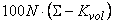
of the variance swap. At maturity, the
payoff of a volatility swap is
Equation 14
where
= notional amount quoted in $ per volatility point (hence the
factor of 100)
 = realized volatility
in the underlying asset during the life of the swap
= realized volatility
in the underlying asset during the life of the swap
 = the strike on
volatility
= the strike on
volatility
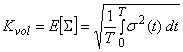
At inception, the strike of the swap is chosen
such that the expected payoff is zero:
Equation 15
This is called the fair volatility.
If the swap is already in effect and is being
valued at some time such that , then the present value of the swap can be calculated by
combining the realized volatility up to the value date with the expected
realized volatility for the remainder of the swap's life. The present value is then

Equation 16
where now

since it is variance, and not volatility, which is
additive.
Volatility Swaps: Replication
It is often said that a volatility swap cannot be
replicated in the same way as the variance swap, as the volatility swap is
sensitive to the volatility of volatility.
Since

Equation 17
the difference between the fair variance and the (square of
the) fair volatility is directly related to the volatility of volatility. This is what is known as the convexity
adjustment.
Although recent results suggest that the volatility swap can
be replicated [1],
the current FINCAD implementation is to take the simplest strategy, which is to
compute the fair volatility as the square root of the expected variance:

Equation 18
By Jensen’s inequality, this approximation always
overestimates the expected volatility. It
amounts to setting the volatility of volatility to zero in Equation 17, and is thus a sensible approximation to make only
when the volatility of volatility is small.
It is then approximately true that one can
replicate a volatility swap with strike and notional  (in units of $ per
volatility point) with a variance swap of strike
(in units of $ per
volatility point) with a variance swap of strike  and notional
  (in units of $ per
volatility point squared) where
(in units of $ per
volatility point squared) where

Equation 19
with latter result arising from

Equation 20
The weights given in aaVolatilitySwap_port
are the weights of the variance swap which approximates the volatility swap.
Functions
|
|
Valuation |
|
Variance Swaps |
|
|
Volatility Swaps |
Naming Conventions
|
Suffix / Prefix |
Description |
|
_iv |
computes the fair variance (volatility) and corresponding
Greeks for a variance (volatility) swap |
|
_port |
computes the weights for European options of various
strikes needed to replicate the payoff of a variance (volatility) swap |
|
_p |
computes the fair value and corresponding Greeks for a
variance (volatility) swap |
aaVarianceSwap2_ iv: Outputs
|
Output Statistic |
Description |
|
fair variance |
the fair variance in units of variance |
|
fair variance as volatility |
the square root of the fair variance |
|
delta |
rate of change in the fair variance per change in the
current value of the underlying stock.
This is the derivative of the fair variance with respect to the
current value of the underlying |
|
gamma |
rate of change in the value of delta per change in the
current value of the underlying stock.
This is the second derivative of the fair variance with respect to the
current value of the underlying |
|
theta |
rate of change in fair variance per one day decrease in
time. This is the negative of the derivative of the fair variance with
respect to time (in years), divided by 365 |
|
vega |
change in the fair variance per 1% change in annual
volatility. All the data in the implied
volatility smile table are bumped by 1% to find this value |
|
rho of rate |
rate of change in fair value per 1% change in the risk
free rate. This is the derivative of the fair variance with respect to the
risk-free rate, divided by 100 |
|
rho of holding cost |
rate of change in fair value per 1% change in the holding
cost. This is the derivative of the fair variance with respect to the holding
cost, divided by 100 |
|
cost of options portfolio (per unit principal) |
the total cost per unit principal of the portfolio of
options needed to replicate the swap |
|
number of market days |
the number of days that the swap is active; calculated
based on the input accrual method |
aaVarianceSwap2_ p: Outputs
|
Output Statistic |
Description |
|
fair value |
the fair value of the variance swap at the value date |
|
sensitivity to realized variance |
rate of change in fair value per 1% change in realized volatility.
This is the derivative of the fair value with respect to realized variance,
divided by 10,000 |
|
sensitivity to implied variance |
rate of change in fair value per 1% change in implied volatility.
This is the derivative of the fair value with respect to implied variance,
divided by 10,000 |
|
theta |
rate of change in fair value per one day decrease in time.
This is the negative of the derivative of the fair value with respect to time
(in years), divided by 365 |
|
rho of rate |
rate of change in fair value per 1% change in the risk
free rate. This is the derivative of the fair value with respect to the
risk-free rate, divided by 100 |
|
combined variance |
the weighted average of the realized variance and the
implied variance in units of variance |
|
combined variance as volatility |
the square root of the combined variance |
|
number of market days passed |
the number of days that the swap has been active; calculated
based on the input accrual method |
|
number of market days remaining |
the number of days remaining in the life of the swap;
calculated based on the input accrual method |
aaVolatilitySwap_ iv: Outputs
|
Output Statistic |
Description |
|
fair volatility |
the fair volatility |
|
delta |
rate of change in the fair volatility per change in the
current value of the underlying stock.
This is the derivative of the fair volatility with respect to the
current value of the underlying |
|
gamma |
rate of change in the value of delta per change in the
current value of the underlying stock.
This is the second derivative of the fair volatility with respect to the current value
of the underlying |
|
theta |
rate of change in fair volatility per one day decrease in
time. This is the negative of the derivative of the fair volatility with
respect to time (in years), divided by 365 |
|
vega |
change in the fair volatility per 1% change in annual
volatility. All the data in the
implied volatility smile table are bumped by 1% to find this value |
|
rho of rate |
rate of change in fair volatility per 1% change in the
risk free rate. This is the derivative of the fair volatility with respect to
the risk-free rate, divided by 100 |
|
rho of holding cost |
rate of change in fair volatility per 1% change in the
holding cost. This is the derivative of the fair volatility with respect to
the holding cost, divided by 100 |
|
cost of options portfolio (per unit principal) |
the total cost per unit principal of the portfolio of
options needed to replicate the swap |
|
number of market days |
the number of days that the swap is active; calculated
based on the input accrual method |
aaVolatilitySwap_ p: Outputs
|
Output Statistic |
Description |
|
fair value |
the fair value of the volatility swap at the value date |
|
sensitivity to realized volatility |
rate of change in fair value per 1% change in realized
volatility. This is the derivative of the fair value with respect to realized
volatility, divided by 100 |
|
sensitivity to implied volatility |
rate of change in fair value per 1% change in implied
volatility. This is the derivative of the fair value with respect to implied
volatility, divided by 100 |
|
theta |
rate of change in fair value per one day decrease in time.
This is the negative of the derivative of the fair value with respect to time
(in years), divided by 365 |
|
rho of rate |
rate of change in fair value per 1% change in the risk
free rate. This is the derivative of the fair value with respect to the
risk-free rate, divided by 100. |
|
combined volatility |
the weighted average of the realized volatility and the
implied volatility |
|
number of market days passed |
the number of days that the swap has been active;
calculated based on the input accrual method |
|
number of market days remaining |
the number of days remaining in the life of the swap;
calculated based on the input accrual method |
Market Data Requirements
They also require a list
of implied volatilities for European options of various strikes (the implied
volatility smile).
The _p function requires
the value date, the effective and terminating dates of the swap, a list of
applicable holiday dates and a discount factor curve (or flat rate) for the
risk-free rate.
They also require the
realized variance (volatility) to date and the fair variance (volatility) for
the remaining life of the swap. The former
can be calculated with the FINCAD functions aaVLT_h or aaVLT_h2,
and the latter can be calculated using the respective _iv function.
Example
Example 1: Valuation
of a Variance Swap using a Portfolio of European Options
On January 2, 2008, we seek to value a variance swap that
came into effect on November 1, 2007 and expires on April 2, 2008. The example
workbook illustrates how to value this swap using the functions aaVarianceSwap2_iv
and aaVarianceSwap2_p.
The workbook also shows how to use aaVarianceSwap2_port
to calculate the portfolio of European put and call options
required for the replication of the variance swap for the remainder of its life.
 Valuation of a Variance Swap using a
Portfolio of European Options Example
Valuation of a Variance Swap using a
Portfolio of European Options Example
Related Functions
Heston Model Pricing
|
|
Valuation |
|
Variance Swaps |
|
|
Volatility Swaps |
Realized Variance / Volatility
|
|
Valuation |
|
Utility Functions |
References
[1]
Carr, P. and Lee, R. (2007) 'Realised volatility
and variance: options via swaps', Risk, May
2007, 76-83.
[2]
Demeterfi, K., Derman, E., Kamal, M. and Zou, J.
and (1999) 'A Guide to Volatility and Variance Swaps', Journal of Derivatives, 6, 9-32; 'More
Than You Ever Wanted to Know About Volatility Swaps', Goldman Sachs Quantitative Strategies Research Notes,
March 8, 1999.
'
Disclaimer
With respect
to this document, FinancialCAD Corporation (“FINCAD”) makes no warranty either
express or implied, including, but not limited to, any implied warranty of
merchantability or fitness for a particular purpose. In no event shall FINCAD
be liable to anyone for special, collateral, incidental, or consequential
damages in connection with or arising out of the use of this document or the
information contained in it. This document should not be relied on as a
substitute for your own independent research or the advice of your professional
financial, accounting or other advisors.
This
information is subject to change without notice. FINCAD assumes no
responsibility for any errors in this document or their consequences and
reserves the right to make changes to this document without notice.
Copyright
Copyright ©
FinancialCAD Corporation 2008. All rights reserved.